Showing posts with label abc wednesday. Show all posts

Wednesday, November 19, 2008

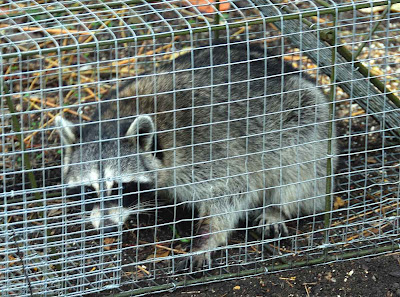
R is for Raccoon

R is also for:
Rascal,
Robber (Masked Bandit)
Relocated (read the story)
Resourceful


Big Raccoon
That's a big trap he's in. (Caught last night)

Don't worry.
He's OK


After I took his mug shot, I took him for a car ride and released him on probation. We live about 10 minutes from Fossil Creek which is a tributary of the Trinity River. Miles and miles of timber, creeks, and bottomlands for him to practice his trade.

I have been trying to trap him for about a week. They wander in and discover the cat food, chicken food, recycle compost, and water. "Looks like a good place to set up housekeeping", they say.

I think there may be another one. Martha and I heard a Raccoon Party on top of the house night-before-last. They really make a lot of noise screeching and chittering.


I guess I'll set the trap again tonight.
Leave a comment.

Have you ever had Raccoon troubles?

Troy and Martha

ABC Wednesday Round 3 is here.
.

Tuesday, August 26, 2008

Flies, Frogs, and Flowers

.

A collection of "F's" for your enjoyment.
Click on the photographs for details.


Fruit Fly (Delphina picta)
Picture-winged Fly

Closely resembles the Picture-winged Fly (Tritoxa sp.) posted by Marvin(click here) a while back.
The Delphina is recognized by the 2 white triangles on the leading edge of the mostly black wing as opposed to the white stripes for Tritoxa.

These is a great group of flies - the Fruit Fly family (Tephritidae)

.........................................

Tachnid Fly
Trichopoda sp.

The larvae of the Tachnid are parasitic on other insects and caterpillars.

.........................................


Mallophora sp. (probably orcina)
Robber fly (Southern Bee Killer)


This robber fly feeds almost exclusively on bees and wasps.

..........................................

Frog
Come on in, the slime is fine.
Free beauty treatment mud pack.


.............................................


Flowers make a fine "F"

Partridge Pea ( Cassia fasciculata)
Notice the very cool stigma

This is an interesting 5 petal flower. The upper 3 petals are red-spotted at the base. the lower 2 petals are cupped. The flowers are borne on a short cluster, but only one opens at the time. Notice yesterday's flower above is closed. The leaves are divided into 8-15 opposite pair leaflets. The foliage is partially sensitive and partially closes when stroked.

Notice the small orange gland at the base of the leaf. This produces nectar which the ants use as a food source. Notice the small ant on the way up to collect dinner (or a snack).


..............................................


Fireweed
Near the Arctic circle


..............................................


Foxglove
Photographed on the side of a cliff,
overlooking the Pacific Ocean


..............................................


Click on the photographs for details.


I hope you enjoyed the "F" post today.
Leave a comment.
Vote for your favorite so that we will know what you like to see.

Troy and Martha

ABC Wednesday Round 3 is here.
.

Tuesday, August 19, 2008

Elfins and Egrets

w/ some Pink Evening Primroses


Henry's Elfin
One of my favorite butterflies. Not bright and showy, but dark and fast flying. Why do I like them? Because they are one of the earliest hatching butterflies in the Ft. Worth area. We always start looking for them when the redbud trees start to bloom.


Egrets
A very cool and calm bird.


Snowy Egret
Notice the yellow shoes


Great Egret
Notice all of the snails on the grass stems.


And finally some flowers


Evening Primroses (Pink)
Growing wild in my front yard. Photo taken at sunset.


Be sure to click on the photos for full page views (only ~75KB).

Troy and Martha

ABC Wednesday Round 3 is here.

Tuesday, August 12, 2008

An ode to "D"

.

Driving in the Dirt,
Deadhorse bound,
on the Dalton Haul Road, while
Displaying a license tag containing a D.

a perfect Day
24 hours of Daylight,
North of the Arctic Circle

Stopped in order for Martha to view wildlife in the
Distance.


Another D photographed in the Alpine regions of the mountains......

Dwarf fireweed
(Be sure to click on the photos for a Dazzling view)


a Different type of landscape,
a few thousand miles to the South
Desolate - Death Valley

Update: I had better add a Dragonfly.

Blue Dasher (Pachydiplas longipennis)


Troy and Martha

ABC Wednesday Round 3 is here.

Tuesday, July 22, 2008

Amberwings


A study of the
Eastern Amberwing (Perithemis tenera)

A small, stocky, golden dragonfly of the Central, Southern and Eastern U.S.. One of the smallest in North America.

The male usually has entirely amber wings with reddish stigma (the small colored area near the tip of the leading edge of the wing). The full and correct name for the stigma is Pterostigma. The female stigma is usually dark with some reddish coloration. In the female the body has similar coloration and the wings lack much amber coloration. The wings in the female will have variable amounts of dark patches. In Southern populations, both sexes often have more spotting.

They usually perch horizontally on the tips of emergent plants usually along the shoreline. Both sexes are considered wasp mimics. When perched, they often move the wings and abdomen up and down in a wasplike manner.


Click on the photos for better looks at their variability.


Female
Note the excessive dark patches and brown stigma.


Female
Dark patches replaced with small amber patches on the hind wing.
Note the two-toned eye.


Male
Fully amber wings and red stigma


Male
Note the chevron markings on the abdomen.


Female
Beautiful example of average coloration.


The old style ABC wednesday is here.
Thanks Denise.


Troy and Martha
Texas Travelers

Tuesday, July 15, 2008

Zephyr and Zebra

Zephyr Definition:
A Gentle Breeze or
A West Wind


A Gentle Breeze off of the Pacific Ocean from the West

Fulfills both Meanings
Where the Klamath River runs into the Pacific Ocean.


Zebra heliconian
(Notice the lack of yellow - Rare)


To play, visit ABC Wednesday,
mrsnesbitt's place. Click here.


Troy and Martha

Tuesday, July 1, 2008

Xenophyte and Xanadu

.
Xenophyte
An introduced species (also known as naturalized species or exotic species) is an organism that is not indigenous to a given location but instead has been accidentally or deliberately introduced to a new location by human activity or by natural means

House sparrow


Kubla Khan

OR, A VISION IN A DREAM.
A F
RAGMENT.

Samuel Taylor Coleridge


In Xanadu did Kubla Khan
A stately pleasure-dome decree :
Where Alph, the sacred river, ran
Through caverns measureless to man
Down to a sunless sea.
So twice five miles of fertile ground
With walls and towers were girdled round :
And there were gardens bright with sinuous rills,
Where blossomed many an incense-bearing tree ;
And here were forests ancient as the hills,
Enfolding sunny spots of greenery.


Forest of Xanadu

(Click on the photo to see the sunny spots in the Ancient forest)

Troy and Martha
.

Tuesday, June 24, 2008

W is for

Wide, Whale, Water, and Wear


A Wide Sitka Spruce

Rain Forest Monarch


The temperate rain forest is dominated by Sitka Spruce. Except where it penetrates valleys such as Hoh, the Sitka Spruce grows along a narrow coastal strip from northern California to Alaska.

High rainfall, fog, and ocean moderated temperatures create optimum growing conditions for these monarchs. This is one of the largest Sitka Spruce trees in the United States.

Height……………………......... Over 270 feet
Diameter at chest height… Over 12 ½ feet
Age………………………........... ~ 525 years

Martha was having a hard time measuring it.


Whale Breaching
Alaska


Around 90% of the body clears the water before the whale turns to land on its back or side. "Belly flops" also occur but are less common. In order to achieve 90% clearance, a Humpback needs to leave the water at a speed of eight metres per second or 29 km/h.


Water and Wear

With a little help from lichens


Living organisms may contribute to mechanical weathering as well as chemical weathering. Lichens and mosses grow on essentially bare rock surfaces and create a more humid chemical microenvironment. The attachment of these organisms to the rock surface enhances physical as well as chemical breakdown of the surface microlayer of the rock. On a larger scale seedlings sprouting in a crevice and plant roots exert physical pressure as well as providing a pathway for water and chemical infiltration. Burrowing animals and insects disturb the soil layer adjacent to the bedrock surface thus further increasing water and acid infiltration and exposure to oxidation processes.


To participate, visit ABC Wednesday, mrsnesbitt's place. Click here.

Troy and Martha

Tuesday, June 17, 2008

Vermillion Cliffs and Victim

V.

Victim of Time and Ravages by the Elements
(Click on the photographs for best viewing)
by Martha

You know how Martha likes B/W. I think she did a good job on the B/W,
considering it was heavy overcast with rain and not much contrast.

It was photographed at
Newberry National Volcanic Monument
Deschutes National Forest
Oregon

In November of 1990, Newberry National Volcanic Monument was created within the boundaries of Deschutes National Forest. Managed by the U.S. Forest Service, this monument provides a unique opportunity to view the Lava Lands of central Oregon.

Newberry National Volcanic National Monument includes 50,000+ acres of lakes, lava flows, and spectacular geologic features in central Oregon. The highest point within the Monument is the summit Paulina Peak (7,985 ft.), showcasing views of the Oregon Cascades and across the High Desert. The summit area of Newberry Volcano holds two sparkling alpine lakes full of trout and salmon.


Vermillion Cliffs
by Troy

The above photo is a composite of two photographs to produce the panorama. Notice Highway 89A in the bottom right hand corner for perspective and scale. This route by the cliffs is the only east route of get to the North Rim of the Grand Canyon.

The Vermilion Cliffs are the second "step" up in the five-step Grand Staircase of the Colorado Plateau. Reddish or vermilion-colored cliffs are found along U.S. Highway 89 and U.S. Highway 89A near Kanab, Utah (and near Navajo Bridge in Arizona).

We stopped at Navajo Bridge to photograph the rafts on their way down the river. We were also looking for the California condor. They had been seen in this region. We didn’t see one here but we did see and photograph one on the North Rim of the Grand Canyon. It was a small dot on the photo, but we did get a look with our binoculars.

The Cliffs extend from a location near Page, Arizona and west for a considerable distance, in both Arizona and Utah. 112,500 acres (455 km²) of the region were designated as the Paria Canyon-Vermilion Cliffs Wilderness in 1984, and an even greater area was proclaimed Vermilion Cliffs National Monument in 2000. Famous locations in the cliff area include Lee's Ferry, Glen Canyon (a national recreational area), The Wave, Coyote Buttes, and others.

The cliffs sat astride an important route from Utah to Arizona used by settlers during the 19th Century. The area was thoroughly explored by the Mormon pioneer and missionary Jacob Hamblin who started a ranch at the base of the cliffs in House Rock Valley. Modern U.S. Highway 89A basically follows the old wagon route past the cliffs through House Rock Valley and up the Kaibab Plateau to Jacob Lake.

The Vermilion Cliffs are made up of deposited silt and desert dunes, cemented by infiltrated carbonates and intensely colored by red iron oxide and other minerals, particularly bluish manganese. In the spring, after a good winter rain, the valley between Highway 89 and the Vermilion Cliffs will be covered with a carpet of desert mallow and other spring flowers.

To play, visit ABC Wednesday, mrsnesbitt's place. Click here.

Troy and Martha

Tuesday, June 10, 2008

From Upper to Under (U)

w/ Udder in between

Up on top of the Mountains
Near Keno, Yukon, Canada


Udder
Where the baby Stone Sheep gets his milk.
This is a two spigot model.
Photographed in B.C. Canada


Under the Ice
Ice cave Above Valdez, Alaska
(photographed by my sidekick, and
top photographer of the Expedition - Martha)


The river of water must have been a lot bigger earlier in the Spring to have cut a hole or ice cave this large. The cold wind was really whistling coming through the tunnel. I could see light at the other end of this river tunnel (Cave), but wasn’t too sure about the stability of the ice. I sure would like to have explored it to the other end. There are a lot of Glacier and Ice Fields above Valdez.


To play, visit ABC Wednesday, mrsnesbitt's place. Click here.

Scroll down to see:
Mt. Rainier and
Scott's Bluff

Troy and Martha
Texas Travelers

Tuesday, May 27, 2008

Sunsets - Yellowstone and Golden, B.C.

ABC Wednesday
Eye Candy
For Your Viewing Pleasure

(Click on the photographs for the full Sunset effect)

Looking for our Campground
Golden, British Columbia

Martha shot this through the front windshield as we were going down the road at 70 mph. The Vibration Reduction Lens was on active. She only had about 10 seconds before the flare from the sun was gone. She grabbed the camera and ripped off about 10 shots. This is the only one that had the effect she was looking for. The cool blue and strong orange and yellow contrast was outstanding. Wish you could have been there and, "I wish this was my photograph", said Troy

Yellowstone Sunset
Totally Un-Retouched.
Exactly as Shot


Another "Martha Photo" through the front windshield as we were going down the road. The beautiful colors were gone in just a few seconds. If we had found a place to pull over and got out of the car, it would have been too late.

The moral to this story is, "Keep your front windshield clean".


To play, visit ABC Wednesday, mrsnesbitt's place. Click here.


Photography by Martha
Driving by Troy

Tuesday, May 20, 2008

R - Red and Rest

ABC Wednesday

Red
Richard the Red
Richard the Rhode Island Red
Richard the Rhode Island Red Rooster


Richard Resting
Boss of Our Backyard


Rest Area
Texas Roadside Picnic Area
New Paint for Memorial Day, Texas Flag


To play, visit ABC Wednesday, mrsnesbitt's place. Click here.

Troy

Tuesday, May 13, 2008

ABC Wednesday "Q"

Quadruped

The Dall Sheep (originally Dall's Sheep, sometimes called Thinhorn Sheep), Ovis dalli, is a wild sheep of the mountainous regions of northwest North America, ranging from white to slate brown and having curved yellowish brown horns. There are two putative subspecies: the northern Dall Sheep proper (Ovis dalli dalli) which is almost pure white, and the more southern Stone Sheep (also spelled Stone's Sheep) (Ovis dalli stonei), which is a slaty brown with some white patches on the rump and inside the hind legs.


Thinhorn Sheep (Ovis dalli stonei)
King of All He Surveys
(Click to see the King up Close)

Photographed in Alaska
Across a Canyon


Research has shown that the use of these subspecies designations is questionable. Complete colour integradation occurs between white and dark morphs of the species with intermediately coloured populations, called Fannin's Sheep (Ovis dalli fannini), found in the Pelly Mountains and Ogilvie Mountains of Yukon Territory. Mitochondrial DNA evidence has shown no molecular division along current subspecies boundaries, although evidence from nuclear DNA may provide some support. Also at the species level current taxonomy is questionable because hybrdization between Ovis dalli and Ovis canadensis has been recorded in recent evolutionary history.

The latter half of the Latin binomial dalli is derived from William Healey Dall (1845-1927), an American naturalist. The common name Dall Sheep or Dall's Sheep is often used to refer to the species Ovis dalli. An alternative use of common name terminology is that Thinhorn Sheep refers to the species Ovis dalli, while Dall's Sheep and Stone's Sheep refer to subspecies Ovis dalli dalli and Ovis dalli stonei.

The sheep inhabit the subarctic mountain ranges of Alaska, the Yukon Territory, the Mackenzie Mountains in the western Northwest Territories, and northern British Columbia. Dall sheep are found in relatively dry country and try to stay in a special combination of open alpine ridges, meadows, and steep slopes with extremely rugged ground in the immediate vicinity, in order to escape from predators that cannot travel quickly through such terrain.

Male Dall Sheep have thick curling horns. The females have shorter, more slender, slightly curved horns. Males live in bands which seldom associate with female groups except during the mating season in late November and early December. Lambs are born in May.

During the summer when food is abundant, the sheep eat a wide variety of plants. During the winter diet is much more limited and consists primarily of dry, frozen grass and sedge stems available when snow is blown off, lichen and moss. Many Dall Sheep populations visit mineral licks during the spring and often travel many miles to eat the soil around the licks.

The primary predators of Dall Sheep are wolves, coyotes, black bears, and grizzly bears; golden eagles are predators of the young.

Dall Sheep can often be observed along the Alaska Highway at Muncho Lake and at Sheep Mountain in Kluane National Park and Reserve, as well as near Faro, Yukon (Fannin's Sheep).


To play, visit ABC Wednesday, mrsnesbitt's place. Click here.

We saw all 3 types on our driving trip to Alaska. You need to have a really good reason to want to go to Faro, Yukon. It's a beautiful drive but out of the way.

I probably should have saved this for Skywatch Friday because you have to watch the ridge line to see them silhouetted against the sky.

Troy and Martha

.
Tuesday, May 6, 2008

ABC Wednesday

The Letter P
from different States


Pacific
Ocean at Klamath River, California

Painted
Desert, Arizona

Path
of Ferns, Washington

Pebbles
Under Water, Glacier NP, Montana


Pennant
Dragonfly, Texas


To play, visit ABC Wednesday, mrsnesbitt's place. Click here.
Troy and Martha

.

Tuesday, April 29, 2008

ABC Wednesday "O"

.
"O" is for the "Ocean Edges"
Texas Gulf coast


"O" is also for Ornate O's used to spell "Ocean"

To participate in ABC Wednesday go to mrsnesbitts place. Click here.


Troy